 Pasadena City Hall (July 2024)
Located northeast of Los Angeles County, Pasadena is the most-populous city in the San Gabriel Valley. It has a long and culturally-rich history as a resort town, and today is a notable hub for higher education and scientific research. Given that it’s a bit out-of-the-ways from Downtown or the Westside, Pasadena has a more laid-back, suburban feel to it, while still having a vibrant food and cultural arts scene to enjoy.
Originally the land of the Tongva Nation (specifically, the Hahamog-na tribe), the first settlements were built on present-day Arroyo Seco, a seasonal river. The area exchanged hands over the centuries from Spain to Mexico to the US. It was originally named “Indianola” after many residents from Indiana migrated over to escape the exceptionally-harsh winter in 1872. Later, the city was renamed to “Pasadena,” aka “of the valley” in the Chippewa language. In 1886, Pasadena officially became a city, the second one in all of Los Angeles County.
*fyi It’s important to note that the Chippewa tribe never inhabited Los Angeles, let alone California. The Chippewa lived in the Midwest; the name “Pasadena” had been suggested by Dr. Thomas Elliott, who had a friend who interacted with the tribe in Minnesota. Therefore, the name is an erroneous nod to the indigenous people of the area– of course, the white settlers had to get it wrong!*
Pasadena became a booming resort town between 1886 and 1941, as it was a popular destination for the rich from the East Coast to holiday during cold winters. As a result, many hotels were built to accommodate the influx, and the city thrived in tourism until the Great Depression, when sadly, many hotels shuttered. Today, only three survive, including the Vista del Arroyo (est. 1920), which houses the Federal courthouse today.
 Vista del Arroyo
Traditions-wise, a notable event is the Tournament of Roses, held every year on New Year’s Day. A tradition since 1890, the Tournament of Roses is a colorful parade with flower-covered floats, marching bands, and lots of fanfare; it’s then followed by the Rose Bowl, the national college football game that’s also held annually on New Year’s. Even if you’re not a huge football fan, it’s still great fun!
The city is full of historic architecture, and the 1890s to 1930s saw the rise of American Craftsman-style homes, offering a more home-y, yet still-impressive design to live comfortably. They’re distinctive for their stone and wooden materials, shingle roofs, and wide front porches. One of them, the Gamble House, was constructed in 1909 and was famously-featured in the film Back to the Future.
 Gamble House
Pasadena is a gold mine of beautiful, historic buildings. Besides American Craftsman, there are other architectural styles, including Spanish Colonial and Mediterranean Revival of Pasadena City Hall, popular for wedding photos and famous as the filming location of Pawnee City Hall for Parks and Recreation, one of my favorite sit-coms of all time.
 Pasadena City Hall
 The courtyard
 Archway
There’s also the Beaux-Arts style evident in parts of Old Town Pasadena and the Colorado Street Bridge, the latter constructed in 1912 and spans the Arroyo Seco. The bridge is a work of art, and one gets beautiful views of it at eye-level at Desiderio Neighborhood Park. The Colorado Street Bridge is iconic of Pasadena, and has been featured in many films like The Kid (1921) and La La Land (2016).
 Colorado Street Bridge
Other miscellaneous historic architecture include the Romanesque Revival campanile of St. Andrew’s Catholic Church (founded in 1886), as well as the London-inspired Burlington Arcade, which houses plenty of cafés and stores to shop around in. There are also dozens of hidden alleyways in Old Town Pasadena, named after philanthropists, businesses, and so forth. There’s also the quirkily-named Big Bang Theory Way, after the eponymous sit-com which also takes place in Pasadena.
 St. Andrew’s Catholic Church
 Inside the Burlington Arcade
Speaking of The Big Bang Theory, the show itself is about scientists who work at the California Institute of Technology (“Caltech,” for short), which is an actual university and one of the most-prestigious institutes of technology in the nation. Even if you don’t attend the school, its campus is quite impressive, with a blend of historic and modern, innovative architecture to enjoy a stroll in.
 Gene Pool at Caltech
Pasadena offers tons of activities that can keep anyone– local or tourist– busy for a long time. For the arts, you could spend a whole day visiting the Norton Simon Museum, which houses a lot of fine arts all over the world, including masterpieces from Rembrandt, van Gogh, Picasso, etc. There’s also a small, but lovely collection of Rodin statues outside of the entrance, and the museum also showcases cultural pieces from East and Southeast Asia, with Buddhist statues and woodblocks. You can also enjoy the fresh air outside in the Sculpture Garden with a water lily pond that’s especially stunning in the summer.
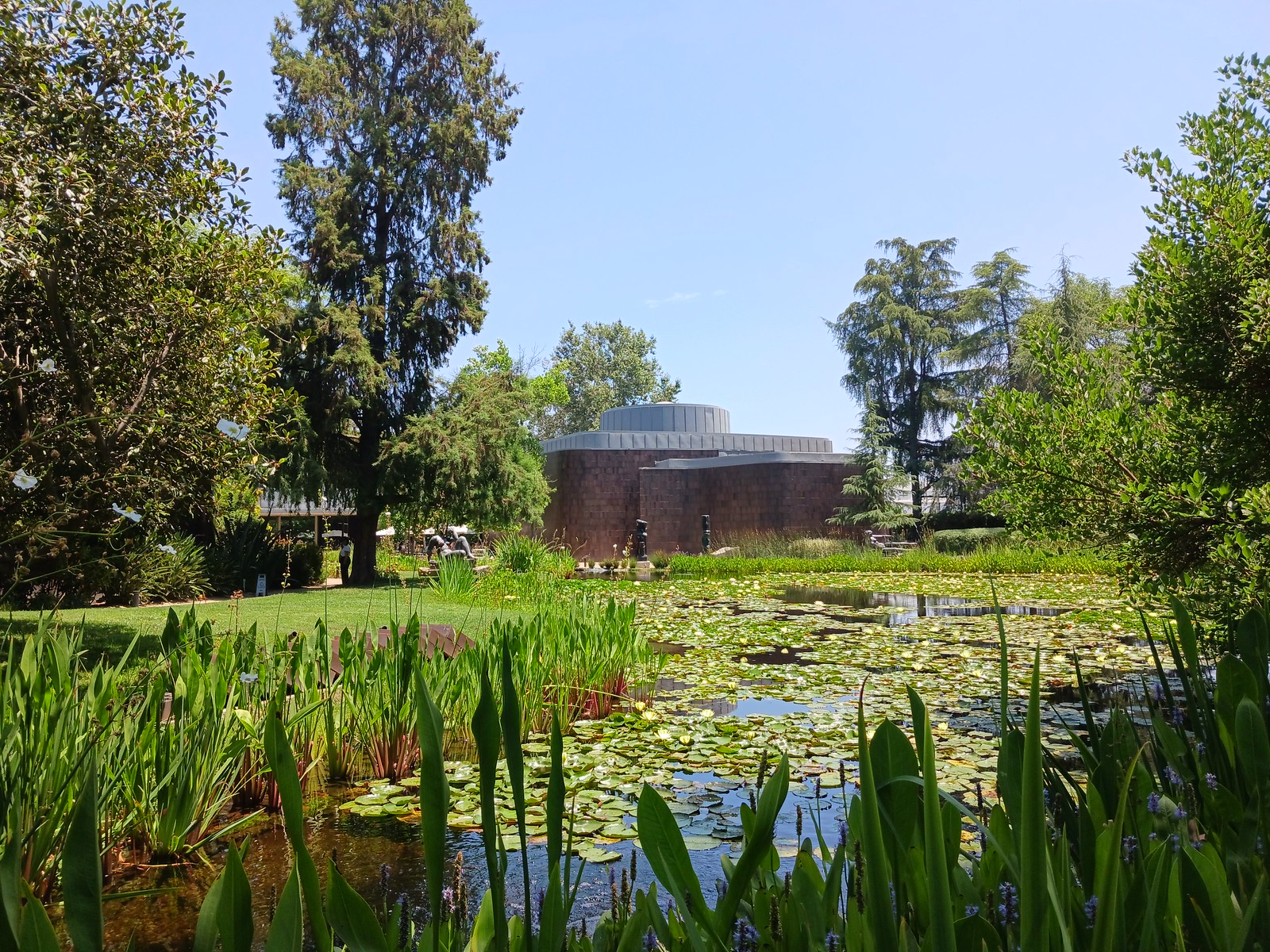 Sculpture Garden at Norton Simon Museum
 Inside the musem
 Monet’s The Artist’s Garden at Vétheuil (1881)
Although not in Pasadena (technically, San Marino), the Huntington Library is a well-known educational and research institution dedicated to rare books and manuscripts, including a 15th-century manuscript of Chaucer’s The Canterbury Tales. The library is worth a visit, but what it’s better-known for is its beautifully-curated botanical gardens– it’s especially stunning in the spring, when everything is in full bloom. I have fond memories of visiting when I was younger, and my family would also enjoy afternoon tea at the Rose Garden Tea Room, with some of the best scones ever. The library might not be in Pasadena proper, but it’s so close that it’s worth a visit all the same.
 Japanese Garden
 Roses at the Rose Garden
For food and shopping, Old Town Pasadena is the place to be. Much of the action takes place on Colorado Street, and you could easily spend the whole day shopping (or window-shopping) before grabbing a bite to eat at any of the many restaurants. There are food options for just about everyone, from sports bar, New American, and Asian cuisine (e.g. Japanese, Thai, Filipino, etc). Afterwards, grab a drink at any of the coffee and tea shops along the block and enjoy the day out and about.
 Colorado Street in Old Town Pasadena
 Sushi at Osawa (still open as of 2026)
 Filipino-inspired brunch at Bone Kettle (still open as of 2026)
 Osmanthus latte and spam musubi croissant at Mandarin Coffee Stand (still open as of 2026)
Although Pasadena is still part of Los Angeles County, it offers a slower, suburban pace of life, all the while having plenty of things to see and do. Many of its historic buildings have been preserved in the past century, which I absolutely love as an architecture nerd. While the downside is that the city gets unbearably hot in the summer (hitting over 100°F/37°C!), it’s a solid place to explore that isn’t as touristy as the Westside, and it showcases another part of LA culture that’s worth a look into.
Thanks for reading, and have a wonderful day! 🙂
— Rebecca


