The smallest country in the world, the Vatican City State isn’t small when it comes to the wealth of history, architecture, and sites to see. With over five million people visiting this small country within Rome each year, it bears testament (pun intended) to just how important this place is for history, art and, of course, religion.
Although it’s possible to visit the Vatican on your own, you can save a lot of time (and headache) from the long lines to St. Peter’s Basilica and elsewhere by paying the extra money for a guided tour, which allows you to skip the lines. My family and I did just that after our second night in Rome: we’d booked the tickets in advance from one of the city tour companies and headed over to the meeting place around 7:30 to start the tour, which would last for a half day.
Tour began at 8:30. From the meeting point, we walked over to the entrance of the Vatican Museums, where we “cut the line” to get in within five minutes– looking at the long line snaking down the street, I was glad that we’d paid a bit extra to get in sans wait. We received box headsets to listen to the tour guide, and we passed our tickets through the scanner to enter. Soon enough, we were officially in the Vatican.
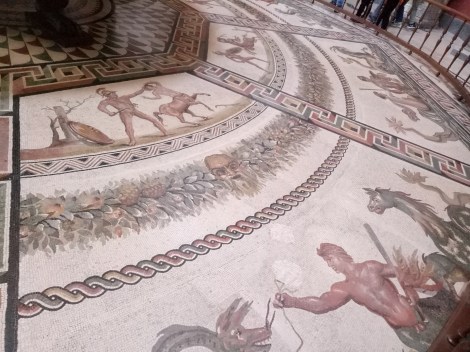
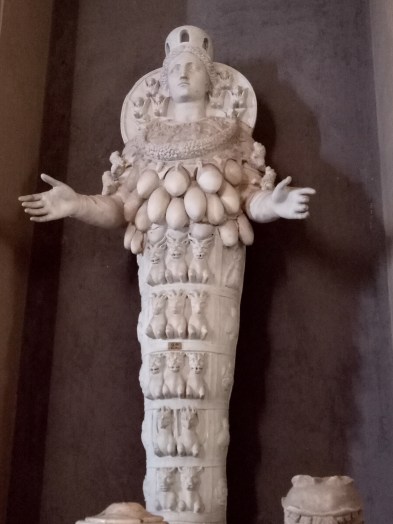
Our first visit for the day was in the Vatican Museums, which is a collection of museums that houses tens of thousands of Renaissance art and classical sculptures that’d been collected by the popes throughout the centuries. We toured through several galleries and courtyards filled with hundreds of life-size Greek sculptures, imperial Roman busts, towering tapestries, and adorned mosaics. The sheer amount of art work inside the museums was unbelievable: our tour guide had told us that, if we were to look at each and every one of the pieces for a minute, we would need two years to cover everything! Of course, we only had about three hours, so we only visited the notable ones.

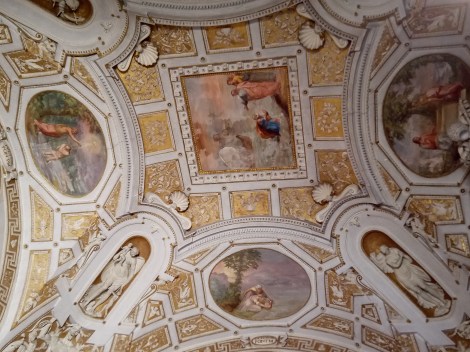
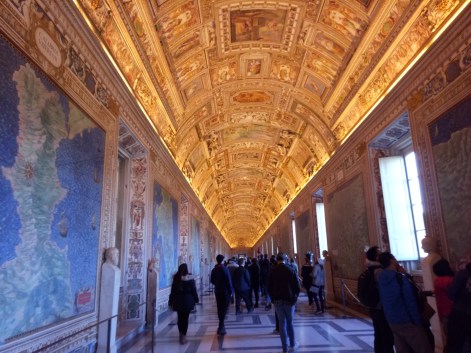
The Gallery of Maps was one of the most-impressive galleries of our visit, with its gilded ceiling guiding us through the long hallway of 16th-century cartographic images of Italy. The maps broke down the various regions of the country, some which don’t even exist anymore. We got views of Tuscany, Liguria, Venice, Sicily, even the now-French Corsica. What made these maps interesting was that their orientation appears to be inverted, unlike what’s depicted on today’s map of Italy– in fact, they’d been drawn from the perspective of the Vatican as it looks out towards the rest of Italy, which I found fascinating as the Vatican really saw itself as the center of the country, despite being autonomous. Aside from that, the gallery itself is a marvel to admire, with its luminous architecture perfect for snapping photo after photo of the long hallway and golden ceiling (as long as you can avoid the crowd of people inside, which is difficult!).
Moving on to the papal apartments, we visited the Raphael Rooms, which are home to some of the greatest frescoes painted by the eponymous painter from the Renaissance. I couldn’t get over just how colorful and detailed each fresco was (in contrast to Michelangelo’s, which are also lovely, but less ornate), and it was a pleasure seeing the famous The School of Athens, in which some of the greatest philosophers in history are depicted, albeit by real people during Raphael’s time. You can only see Raphael himself in the painting, at the very right-hand corner looking directly at the art-goer, perhaps as a sort of commentary on how art imitates life, and how life imitates art.

We made a quick tour through the Borgia Apartments, which once housed the eponymous Spanish royal family. Nothing much is contained in the apartments today, since much of the art work and furniture had been removed. That said, we merely used the apartments as a passageway to the next site, the world-renown Sistine Chapel. Although I’d visited the Vatican before (over eleven years ago), I didn’t get to visit the Sistine Chapel back then– now, I was able to, and to marvel at the incredible fresco, The Last Judgement, painted by Michelangelo.
Prior to entering the Sistine Chapel, our tour guide gave us the run-down of its history: Michelangelo had been reluctant to, even against, doing the fresco as commissioned by the pope of that time, Pope Julius II. Michelangelo didn’t want to accept the project due to the fact that 1) he was a sculptor, not a painter, and 2) he was in disagreement with the Catholic Church over the interpretation of the Bible. It was incredible, then, that he did it anyway: he completed it within four years and, at the same time, made it so that he was interpreting the Old Testament, rather than the New Testament, in the paintings. Michelangelo also made one of the bishops (whom he didn’t like) a half-beast, which was a big insult (“fuck you”), in my opinion– how bad ass!
Unfortunately, we couldn’t take any photos inside the Sistine Chapel– we even saw a few tourists trying to sneak in some pictures, only to be caught and reprimanded by the many guards patrolling the entire chapel. I would’ve loved to have snapped away at the interior, but at the same time, I don’t think the photos would’ve done justice to the sheer size and scope of the fresco– perhaps some things are worth not taking a photo of.
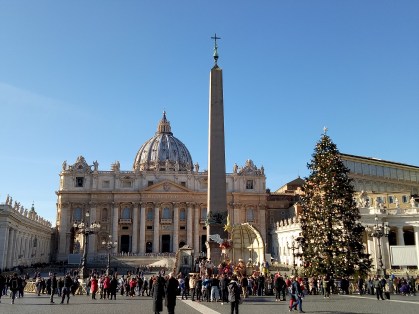
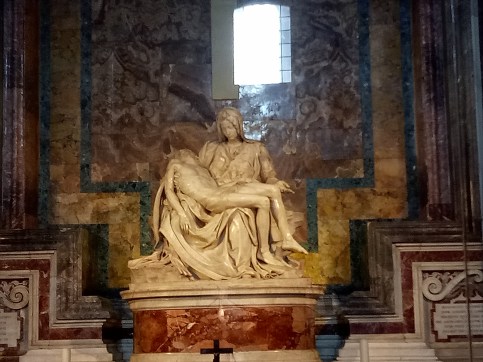
Exiting the Sistine Chapel, our final stop was at St. Peter’s Basilica. As the largest church in the world, it draws in close to 100,000 people each year for pilgrimages. We got views of the massive St. Peter’s Square, where people watch the pope give speeches during important religious functions. We entered the basilica itself, viewing the towering nave, the underground tombs of past popes, and Michelangelo’s the Pietà. I’d visited St. Peter’s Basilica previously, along with having seen the Pietà. Now, the idea of a “youthful” Mary as she watches her 33-year-old son die in her arms, which before seeming very strange, takes on a whole new meaning as I learn that Michelangelo wanted to create her as having “incorruptible purity,” as she’s ironically also known as a virgin. The irony and truth to this piece is stunning, with so much weight and history for such a small sculpture.
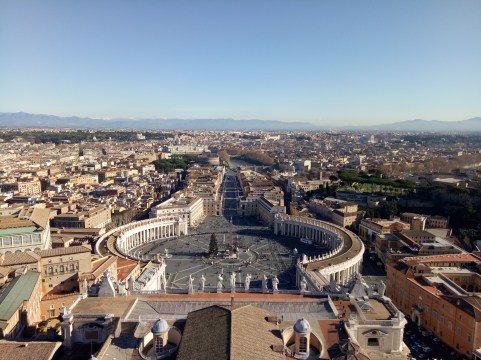
Our tour of the Vatican concluded shortly afterwards, and we were free to linger on or leave. My family and I did a quick visit of the crypts underneath the basilica before I paid to climb the stairs of the basilica for views of the Vatican at the top. The climb proved rather interesting, as there were at times extremely-narrow corridors upon which visitors had to go up one-by-one. The steps sometimes sloped inwards as we were at the dome part of the basilica, which required us to lean against the wall as we continued climbing. The views at the top were pretty good, with a solid shot of St. Peter’s Square at the bottom. Upon descending the basilica, I met up with my family (who’d chosen not to climb) and together, we exited the Vatican for lunch and to return to Rome.
The half-day visit to the Vatican was packed with art and information, but it was all really fascinating to learn about the blend between religion and art. I think that I have a better appreciation for the history behind it than I did over eleven years ago, when I was still a kid. Things make sense to me, and it was a real pleasure getting to (re)admire the architecture and art works which have greatly impacted those of today.
More on my adventures in Italy this past holiday season soon! Coming up: Tivoli & Tarquinia, Italy!
— Rebecca

 Rebecca Goes Rendezvous
Never thought to visit here but you really made it sound good! Great post!
LikeLiked by 1 person
The Vatican is a popular day trip from Rome. Even better that it’s literally inside of the city!
LikeLike