When it comes to traveling, some of us might not have the luxury of spending many days in one place. Whether it’s due to rushed planning or limited vacation time off from work, it can be hectic trying to research and cram in as much as possible into sightseeing a city or country. In the end, it might be exhausting, and it perhaps could detract you from enjoying your adventure away from home.
Having been inspired by the many Internet articles (one of the most-famous including the New York Times’ “36 Hours in…” segment) that showcase ideal itineraries in a set destination, I’d thought that I would also start a similar series on this blog to offer some of my own suggestions of things to do, see, and eat in well-renown cities in the world.
What makes my series different from the others online would be the fact that I’m by no means a professional traveler (e.g. no sponsors, all-paid resorts, etc.), and that what I will suggest are based on my own personal experiences having visited a certain place at least twice, in order to ensure a more-comprehensive outlook on the city itself.
Many online articles in the same vein also tend to cater towards mid-to-upper class travelers who can actually afford hotels and fine-dining restaurants, which I assume many people in their 20’s, even 30’s, can’t have. That’s why I’m catering this series to the budget-friendly, backpack-traveler nomad who doesn’t mind staying in hostels, taking overnight buses, or eating at hole-in-the-wall joints while still getting a fulfilling experience in traveling. This one’s for you, folks!
PS Check out more of my “72-Hour” posts here!
72 Hours in Warsaw: Things to See and Do
Nicknamed as the “Phoenix City,” Warsaw is a city that’s symbolic of destruction and resilience. It’d been a grand and prosperous hub for Central Europe before getting heavily bombed throughout the Second World War; over 85% of its area had been destroyed, but over the next century has shown an incredible comeback with its reconstruction and burgeoning economy– and it’s still developing today.
This Polish capital is home to just over three million inhabitants in its metropolitan area, and is home to a stark contrast between two histories: pre-WWII and post-WWII. Granted, most buildings have been reconstructed (so that many of them are not more than a couple of decades old), but to see the difference between the colorful Old Town and the austere, Bloc-like Palace of Culture and Science offers a variety of architectural structures to examine, from one side of town to the other.
I visited Warsaw twice, the first time in April 2017 and the following two years later in May 2019. Both visits had been brief, two-night stays, but I still managed to see much of the city. Warsaw is large and a bit of a stretch to walk around, but many of the touristy sites are concentrated in clusters, so that you could spend time in one part of town to see a few of the landmarks before catching public transport to another section of the city. Otherwise, you can get a solid workout on-foot!
Personally, I believe 48 hours is enough time to see Warsaw– however, there are plenty of opportunities to take it slow and spend a half-day at one of its many parks (in fact, a quarter of the city is covered in nature!), or to take a day trip to see more of Poland. I will highlight the things to see and do in the Polish capital, should you end up making it over to this under-appreciated city someday:
Day 1
After a light breakfast of coffee and a French pastry at any of the many coffee-chain shops (Costa Coffee, Caffè Nero) along Nowy Świat, one of the major streets in the heart of Warsaw. This one-mile (1.6 km) street was once part of the Royal Route for nobility, and it’s on this path that you can hit up much of the main sights along the way.
If you’re heading from south to north, the first stop would be at the Nicolas Copernicus Monument (Pomnik Mikołaja Kopernika). This statue sits in front of the Polish Academy of Sciences, and we have to thank this 15th-century Polish astronomer for his contributions to science.
Just steps from the monument is the Holy Cross Church (Kościół Świętego Krzyża). One may not be surprised that Poland remains a deeply-religious country, with almost 95% of the population being practicing Roman-Catholics– that said, churches like these are commonplace. But what stands out for this church is what’s inside of it: the buried heart of Romantic composer Frédéric Chopin. Although he spend much of his adult years in France, Chopin remains Polish through-and-through, and his works– lyrical and moody– remain popular in classical music today.
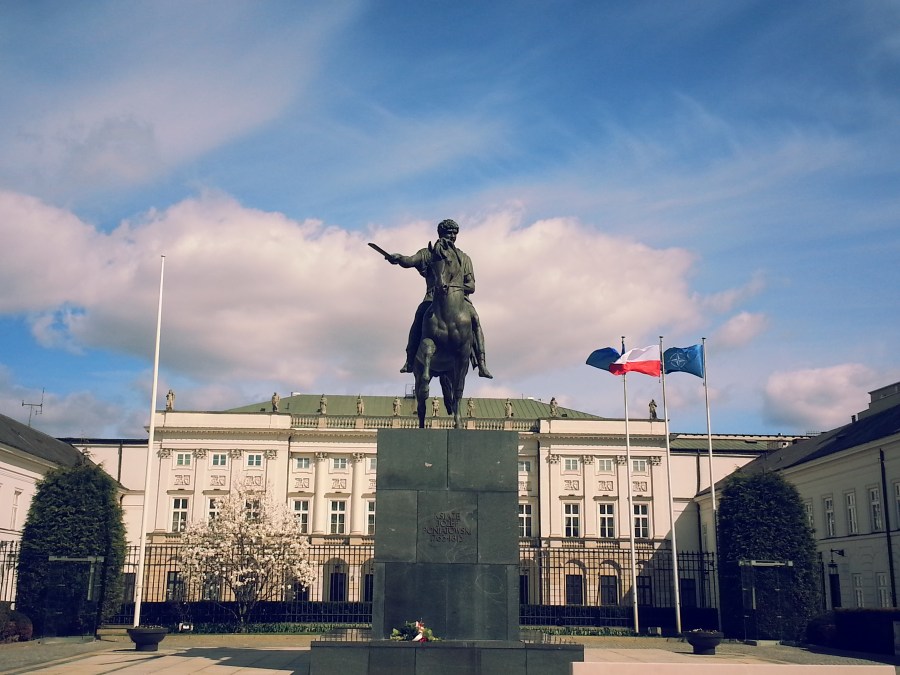
By this point, Nowy Świat becomes Krakowskie Przedmieście, and you’ll pass by the Presidential Palace (Pałac Prezydencki), the seat for the Polish president. Visitors can tour the interior of the palace, but it’s imperative to book ahead of time to avoid the long queues.
Just before reaching the Old Town, you’ll come across St. Anne’s Church (Kościół Akademicki św. Anny), with its bell tower offering the best views of the Old Town Square. Admission is around 4 złoty (0,80€, or $1 USD), but the sights above are fantastic.
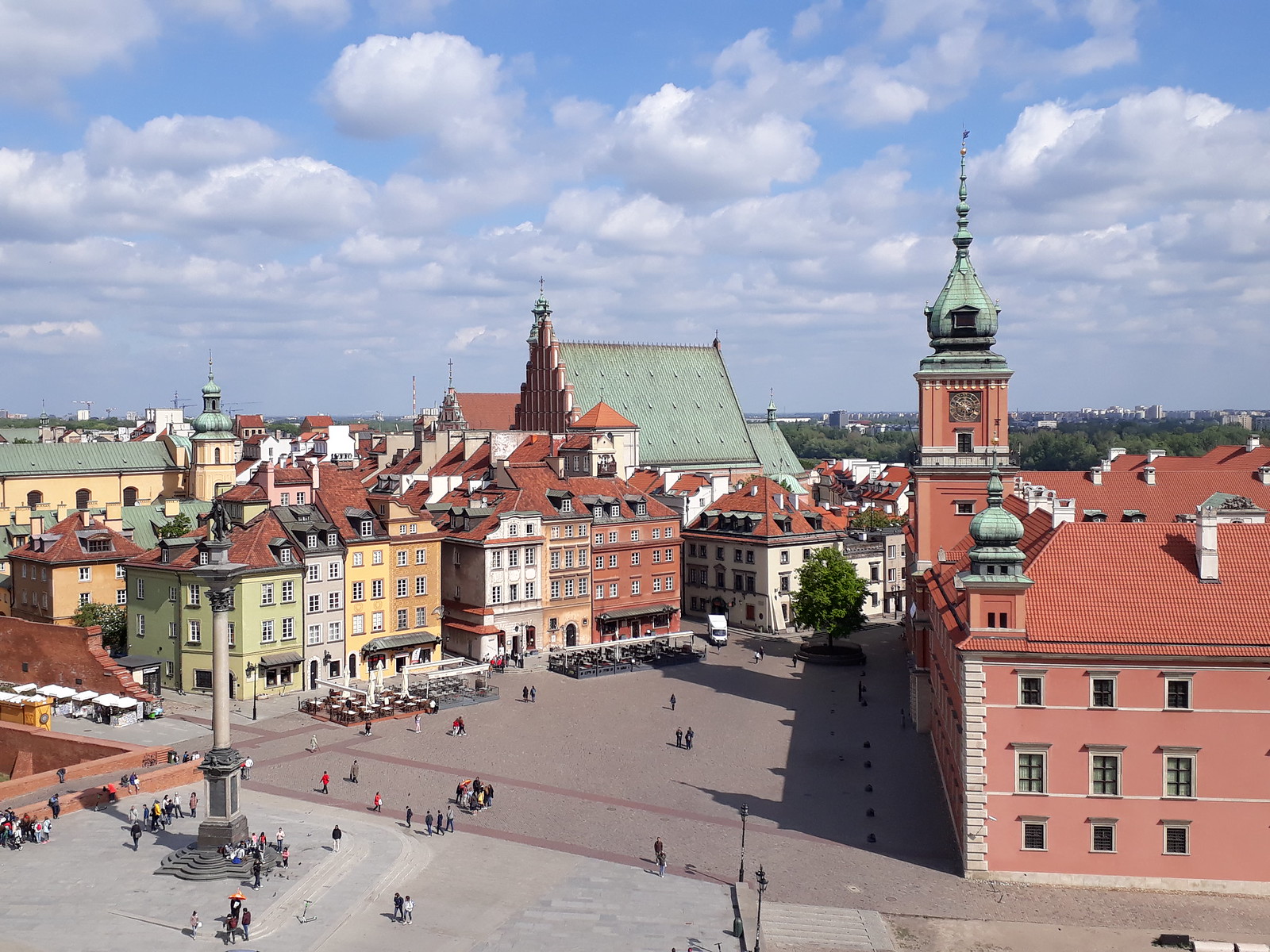 Views of Old Town from St. Anne’s Church bell tower.
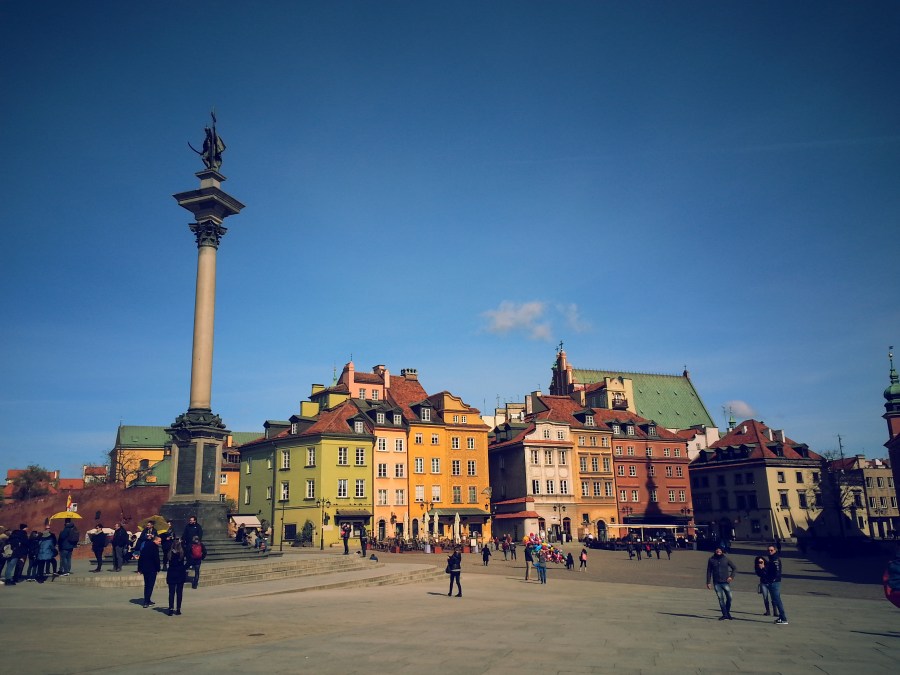
Old Town is a few meters away, and it’s a good idea to take in the colorful buildings that are a replica of a once-thriving city pre-WWII. Admiring the sight, you can’t help but wonder at Warsaw, once nicknamed “Paris of the North.”
By now, it’s more-or-less lunchtime, and there are dozens of restaurants in the Old Town. Granted, they’re tourist traps, but they still offer affordable, Polish cuisine to try out. Besides the pierogi chain Restauracja Zapiecek (which I do recommend), there are also a few bar mleczny (“milk bars”) that are distinctive of Polish culture, as they were once government-subsidized cafeterias for low-price Polish cuisine. Aside from trying the iconic pierogis, there’s also flaki (tripe soup), kielbasa (sausage) and, my personal favorite, gołąbki (stuffed cabbage). If you’re looking for a grab-n-go kind of deal, there’s also zapiekanka, an open-faced sandwich that’s a popular street food.
 Zapiekanka.
The afternoon is spent at two destinations, first one being the Warsaw Barbican (Barbakan Warszawski). This 16th-century fortification has since been reconstructed in the 20th century, and it’s a pleasant stroll along its rustic-red walls before a pop-over at the Warsaw Uprising Monument a street away, a commemoration to the lives lost during the 1944 rebellion.
The second, main destination of the afternoon is at the Royal Castle (Zamek Królewski) back in the Old Town. Just like the other sites, it’s a reconstruction of the 14th-century palace for the royal family, and you can pay 20 złoty (5€, or $5 USD) to check out the interior. While smaller than what you’d see in Versailles or the Schönbrunn (in Versailles and Vienna, respectively), the Royal Castle is still elegant and a lovely reflection of what Polish royalty used to be.
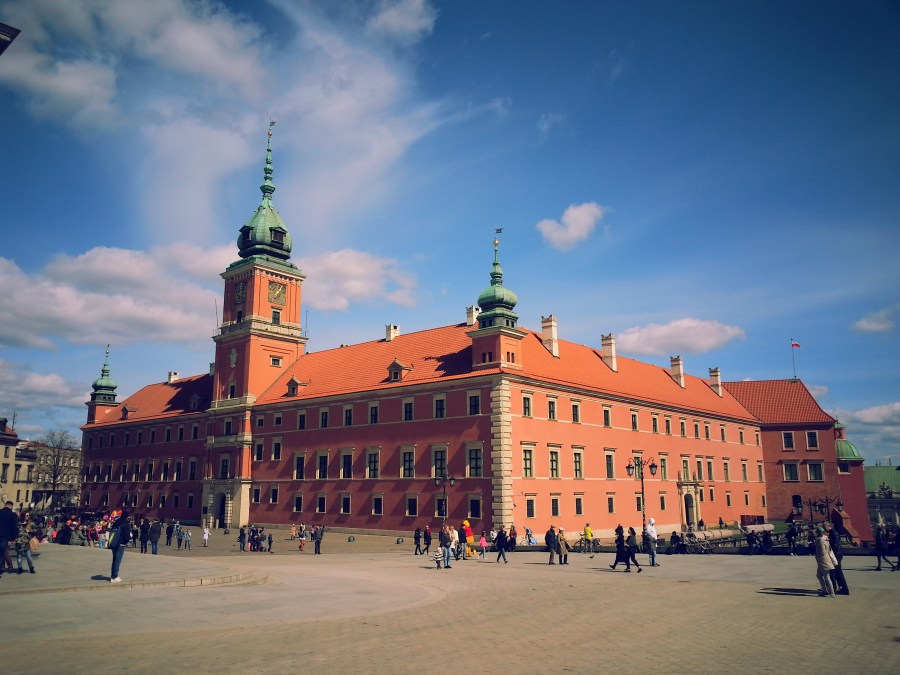
Before heading back to your accommodation for the day, a turn-around at the Tomb of the Unknown Soldier (Grób Nieznanego Żołnierza), a monument dedicated to the lives lost during WWII and the Warsaw Uprising. If you’re lucky, you might also come across the Changing of the Guards, which take place hourly. It’s then a matter of returning to your accommodation for a break before heading out to dinner that night (either for pierogis or a heartier meal with a pint of Tyskie beer). You could opt for a fun night out at the bars and clubs, or otherwise rest up for a long day of travel tomorrow…
 Pierogis and Tyskie beer.
Day 2
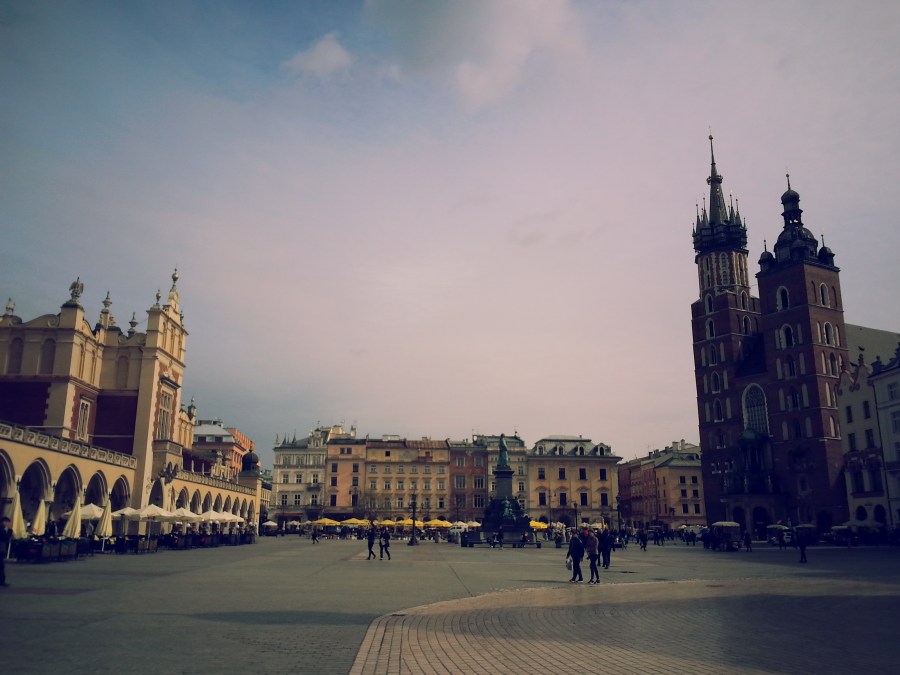
As mentioned, much of Warsaw’s attractions can be covered in 48 hours, which means that you can insert a long day trip into the mix and discover more of Poland. Two options would be to go to Krakow (two hours by high-speed train) or Auschwitz Concentration Camp (four-and-a-half hours by train). There’s also the option to book a guided tour for the latter, to save the headache on time and buying tickets (three-and-a-half hours by tour), but either way, both will be very long days of sightseeing and travel. By the time you return to Warsaw in the evening, you’d most-likely want to grab takeout nearby your accommodation and call it a night.
Day 3
Your last, full day in Warsaw will be an eclectic blend of sites scattered throughout the city outside of the Old Town. There will be some public transport involved, and the first site to get to early is the Warsaw Uprising Museum. As opposed to the historic sites preceding the 20th century two days prior, this museum offers insights into a more-recent history of Poland, particularly the devastating rebellion in 1944. It was an attempt by the Poles to fight off Nazi Germany from claiming the city, and unfortunate the enemy won. Casualties of the Polish resistance group totaled 16,000, with an additional 200,000 civilians killed by execution. The museum offers insight into the tragic rebellion with artifacts from that era– it is free admission on Sundays.
Following the visit, you can either take the tram or walk the 1.2 miles (2 km) to the Palace of Culture and Science (Pałac Kultury i Nauki), another iconic landmark of Warsaw. Imposing and austere, this Bloc-like building was built during the Cold War years but has since detached itself from its Soviet past– today, it houses the cultural arts and venues, including cinema, the Museum of Technology, and event halls. You can also go up to the 30th floor for panoramic views of the city.
 Palace of Culture and Science.
At this point, I would suggest checking out some of the lesser-known sites of Warsaw. Two of them I’d recommend, the first one being the Warsaw University Library Garden, located in the university quarters. The surrounding neighborhood is vibrant and youthful, bustling with students getting to classes, but upon stepping inside the entrance to the botanical garden, you’re greeted with silence and peace. It’s a matter of traversing the glass corridor to head outside to the rooftop botanical gardens, teeming with flowers in the spring and views of the Palace of Culture and Science in the distance– a lovely respite in the heart of town.
 Botanical gardens at the University of Warsaw Library.
It’s a matter of getting lunch before catching the tram east of the city, across the Vistula River to the Praga neighborhood. This part of town has a different feel than the bustling center, as it’s a bit more industrial and run-down. While I wouldn’t recommend venturing here at night, it’s safe in the day, and the second site to check out is the Neon Museum (Muzeum Neonów), a small exhibition situated in a once-abandoned factory. It’s 10 złoty (2€ or $2.50 USD) to enter, and one can pass a bit of time strolling the three corridors of brightly-lit signs that’d been preserved post-WWII. You don’t need a lot of time to cover them all, but it’s a unique spot to get some very-Instagrammable photos.
 Neon Museum.
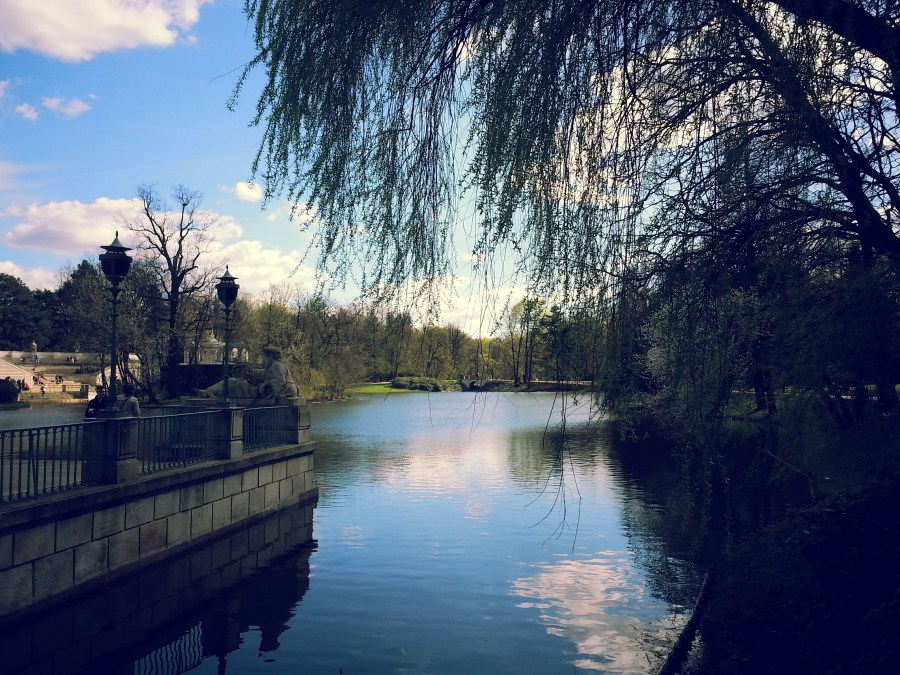
The rest of the day can be spent at the Łazienki Park, south of the city center. You can take the tram over and spend the remainder of the afternoon strolling the massive, 76-hectare land, home to plenty of greenery and some notable sites, including the charming Baths Palace (Pałac Na Wyspie) and the abstract Frédéric Chopin Monument. Overall, it’s a tranquil afternoon in a natural part of the urban city, and it’s a great way to soak up the sun and picnic, especially on a pleasant day.
You have the option of retiring to your accommodation before having dinner out and, if you didn’t have the chance to go out bar-hopping and clubbing two nights before, you can opt to do so on your last night out. Much of the nightlife is concentrated in plac Teatralny and plac Piłsudskiego (adjacent to each other), or along the Podwale or Mazowiecka streets, around the University neighborhood. Either way, both areas are safe at night, so you can be assured a secured walk home in the end. Just make sure you wake up on time to catch your ride home!
Overall, Warsaw is a large city, but doable in a couple of days. Although it may not be as well-preserved as Krakow or other cities in Poland, it remains the country’s capital and offers a blend of beautifully-reconstructed buildings, poignant museums, and natural parks to check out. It’s an understated destination in Europe and very well-worth a visit over.
Have you been to Warsaw before? Let me know!
— Rebecca

 Rebecca Goes Rendezvous
Warsaw looks like a very pleasant and interesting city to visit. Affordable too, judging by the entrance tickets to various monuments and attractions you listed. I’ve been to Krakow and Auschwitz, but somehow the capital city has eluded me. The Royal Palace is quite unique and appealing for, among other things, its understated elegance and simplicity. Thanks for sharing!
LikeLiked by 1 person
Warsaw had been the convenient stop for me coming from France, as there are cheap, direct flights over before connecting with Eastern Europe. Warsaw didn’t capture me as much as Krakow or Auschwitz when I visited for the first time, but a second trip back did it grow on me. I miss the delicious, Polish food there!
LikeLiked by 1 person
I’ve also visited Warsaw and enjoyed the city Rebecca but it looked very different as it was February and very cold and snowy. It was very pleasant then but looks even nicer in the summertime. Thanks for sharing such an interesting 72 hour plan. Marion
LikeLiked by 1 person
I’ve only ever visited Warsaw (and Poland, in general) during the springtime, so I can’t imagine just how bone-chilling it must be in the winter! Then again, I’m sure it’s a LOT cheaper to travel then, though. 😉
LikeLiked by 1 person
Nice presentation of the city, I stayed there a little longer than three days, I even worked several months in the north of the country, but I didn’t manage to see everything you show. Good job!
LikeLiked by 1 person
Nice! I visited Gdańsk up north of the country; where did you work in Poland? Warsaw might be more industrial than Krakow or Gdańsk, but still has its own charm, too! Thanks for reading. 😊
LikeLiked by 1 person
I worked a few monts in Gdynia near Gdansk, but it was too far to visit Warsaw from there.
LikeLiked by 1 person
It was an amazing place ..loved our time there. Enjoyed the food …cabbage rolls and Pierogis were my favorite. So many sites to see.
LikeLiked by 1 person
I LOVE gołąbki (cabbage rolls) and pierogis; I always ordered them whenever I visited Poland. So hearty and comforting! Warsaw truly has plenty of lovely places to check out, and it’s a shame that tourists sleep on this Central European capital!
LikeLike
Very nice description of the city with beautiful phottograph to complement it!Thanks for sharing❤
LikeLiked by 2 people
Thank you!
LikeLiked by 1 person
My pleasure 🙏
LikeLiked by 1 person
I have never been to Warsaw but I had a fantastic holiday in Wroclaw with friends in the East of Poland a few years ago. It was a place I knew almost nothing about, we were just able to get cheap plane tickets and accommodation. Everything ended up being so cheap The food, drinks (including the best cocktails of my life) history and architecture was amazing.
So I really want to get back and see some more of Poland. I have bookmarked this informative post to refer back to when we can finally travel again.
LikeLiked by 1 person
I’ve actually never been to Wroclaw, as I didn’t have enough time during my 10 days in Poland. That will be a destination I’ll check out when I can return to the country someday. Hope you can go to Warsaw soon!
LikeLike
Warsaw was a great city to visit and I would have liked another full day to see a few more things. The view from the Warsaw University Library garden on a spring day looks so relaxing! I didn’t know about the Neon Museum- that looks interesting just to go and see. Pierogis are one of my favourites too and now I feel like some!
LikeLiked by 1 person
Now you got me craving pierogis, too! There aren’t places selling pierogis near me, so maybe I make some! Warsaw is such an understated city, and it’s definitely worth a revisit someday!
LikeLike
its a strange city, a mix of so many elements. That Palace of Science and Culture, I was so excited when I realised I could go up it! And I did!
LikeLiked by 1 person
I didn’t go up the Palace of Science and Culture, despite visiting Warsaw twice. But I can imagine the views are lovely up there!
LikeLike
I’ve only ever eaten frozen pierogis, but I’m sure they taste much, much better fresh in Poland! Seems like an interesting place to visit. Thanks for putting Warsaw on my radar!
LikeLiked by 2 people
Funny enough, I’ve never had frozen pierogis! Fresh pierogis are delicious, and I’ve made them before; they’re actually really easy to make! Hope you can travel to Poland to eat the “real deal!”
LikeLiked by 1 person
Amazing guide – thanks Rebecca. I can’t wait to visit one day 🙂
LikeLiked by 1 person
You’re welcome; I hope you can visit soon!
LikeLike
Thanks for the post! Polands been on the radar, but always seems to have a few other places ahead of it. A few day stopover may be the key to getting introduced to the country.
LikeLiked by 1 person
Definitely! Even a day in Warsaw would offer a good taste of what Poland’s all about. I hope you can go someday!
LikeLiked by 1 person
I love your new travel serious, Rebecca, it is such a creative idea 🙂 I’ve never been to Poland or any of its beautiful cities, but would love to explore it and see as much as possible one day, Tatra Mountains including. I love Warsaw’s Old Town and its its colourful tenement houses and the unique atmosphere of its narrow streets. I’d say they have fantastic Christmas Markets in those city squares. Thanks for sharing and have a nice weekend. Aiva 🙂 xx
LikeLiked by 1 person
Poland is one of my favorite European countries to visit. I hiked the Tatra Mountains in 2017, and despite being in April, it was still snowing! Definitely worth it for its scenic nature. I hope you can go someday to experience its beauty!
LikeLiked by 1 person
Krakow is on my bucket list but I’m very surprised to see that Warsaw has so much to offer. Thanks for the tips. Maybe I could travel somewhere next year? 🙂 This year it’s just not possible, because of my new work situation and because I need to get my vaccine.. I’m finally on the list so >I hope to get it soon
LikeLiked by 2 people
I’ve been to Krakow, and I would say that its Old Town is better-preserved than Warsaw’s, hence why more tourists go there and like it more. But I would say that Warsaw has its charm, too, and I encourage you to go when you can! 🙂
LikeLike
Great post. Made me want to go.
LikeLiked by 1 person
Hope you can some day!
LikeLike
A charming old town area! I was just passing through and spent a day there. Interesting dichotomy between history and modern life. Walked to the Chopin Museum but it was closed because the electricity was out. I like your selections.
LikeLiked by 1 person
Thanks for reading! Warsaw certainly is a lovely city, despite its tragedies. Hope you can return to see the Chopin Museum!
LikeLiked by 1 person
Thank you for this informative post, Rebecca. I have never been to Poland and this makes me interested to go (someday soon I hope). I look forward to more of your 72 hours posts.
LikeLiked by 1 person
Thank you! Poland is one of my favorite countries I’ve visited in Europe, and I hope you can go to learn about its history, architecture, and incredible food. More of my “72 Hours In…” series to come later this year!
LikeLiked by 1 person
Great post! I have never been to Warsaw but remember that I almost booked a weekend there when I was in Vienna, it seems like a very nice city to walk around and have a chill time! 😊
LikeLiked by 1 person
I highly recommend Warsaw! Some people might not find it as pretty or accessible as Krakow, but I believe it still has a lot of wonderful gems to check out. Hope you can go someday!
LikeLiked by 1 person
😍😍 great one
LikeLiked by 1 person
Yum, Pierogis! Cool neon museum. The traditional architecture is very picturesque, looks like a movie set. : )
LikeLiked by 1 person
The Old Town is reconstructed, so I can see why it looks like a movie set. There’s a lot to see in Warsaw than one might think!
LikeLiked by 1 person
Thanks for the virtual tour. 🙂
LikeLiked by 1 person