
A notable university town, Salamanca is a city steeped in its love for higher learning. Its university attracts thousands of international students to the city each year, one of the highest in the country (16%). This western Spanish city is equally-filled with history, along with its passion for education, that draws many in for a piece of its golden, Castilian charm.
Salamanca had been one place that I really wanted to visit for some time. I made it as a day trip from Madrid, as part of my northern Spain itinerary this past June. Travel time one-way averages about two hours, but I didn’t mind the commute. If anything, I was more than willing to make the trip over, as I really wanted to see the city.
That said, I caught the morning train around 9:00 from the Madrid Chamartín station, one of the several stations of the Spanish capital. Chamartín primarily serves rides to destinations northwest of the country, along with an international one to Lisbon. It was evident, then, that I would use Chamartín to visit Salamanca, as it’s 200 kilometers (120 miles) west; I opted for the Renfe AVE (high-speed train) to get me there sooner than later, so that I could enjoy as much time there as possible.
I pulled into Salamanca’s train station near 11:00, and from there I made my way on-foot to the city center. First stop of the day was at the famous cathedrals of Salamanca. In fact, there are two main cathedrals of the city: the Old and the New. The former was constructed between the 12th-14th centuries in Gothic style and the latter between the 15th-17th centuries in Baroque style. The New Cathedral had been built when the Old one began to fall out of favor over the centuries; as a way to continue to get people to attend church, the city opted to construct a new one.

One enters the cathedrals through the New one– in fact, the Old Cathedral connects with the New, so that upon completing the visit of the New Cathedral, one can cross over to the Old one. I paid about 5€ to enter, which wasn’t bad– after all, I would be seeing two cathedrals, along with the cloister inside. Pretty good deal, overall!
Just before entering the New Cathedral, one can also spot the carving of an astronaut on the building’s walls. Actually, I’d been meaning to find the astronaut carving since looking it up on Atlas Obscura, and it’d taken me forever to spot it as I’d circled the cathedrals at least twice. Lo and behold, it ended up being situated right at the entrance I’d gone through!
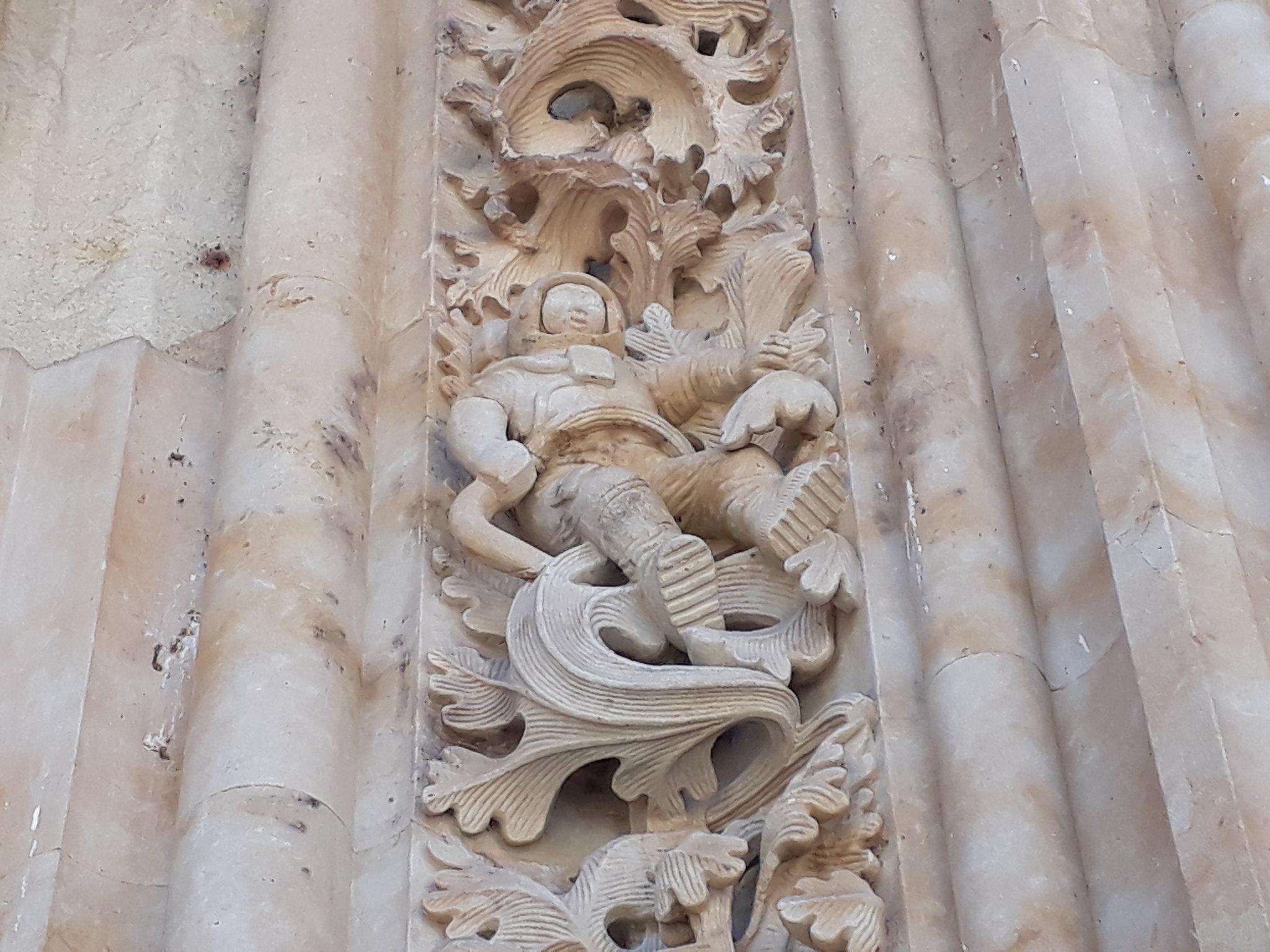
Despite the New Cathedral being completed in the 17th century, the astronaut carving was actually added in 1992 during its restoration. The astronaut was specifically added to represent the accomplishments of mankind in science and technology, to which I found incredibly fascinating. It was a touch of modernity amidst a 500-year-old building, and it was a quirk that I enjoyed during my visit.
In fact, the astronaut carving wasn’t the only architectural oddity I encountered while in Salamanca. I also came across several others, including the Casa de las Conchas, a 15th-16th century building covered in carved seashells (hence the name). The seashells are a symbol of the Santiago order, as famously represented by the Camino de Santiago itself. As Salamanca is one of the destinations on this pilgrimage, it’s no wonder that the building pays tribute to it, along with Saint James (the patron saint) himself.

Another quirky monument is the frog statue, located on top of one of the skull carvings in front of the main university’s doors. Due to its extremely-small size, the frog statue has become kind of a game among visitors, who spend at least several minutes trying to spot this minuscule carving. I had to really zoom in on my camera just to get a clear image of it!

There are two stories as to why the frog statue exists. One of them was that the frog represents sexual temptation, and the skull upon which it rests is the result of death due to the temptation. Another story refers to that of Prince Juan in the 15th century, who died young. The skull represents his death, and the frog symbolizes his doctor, Doctor Parra, who tried in vain to save him. Whatever the meaning of the frog statue is, today it’s meant as a symbol of good luck, as whoever can spot it can be guaranteed luck on his/her university exams.
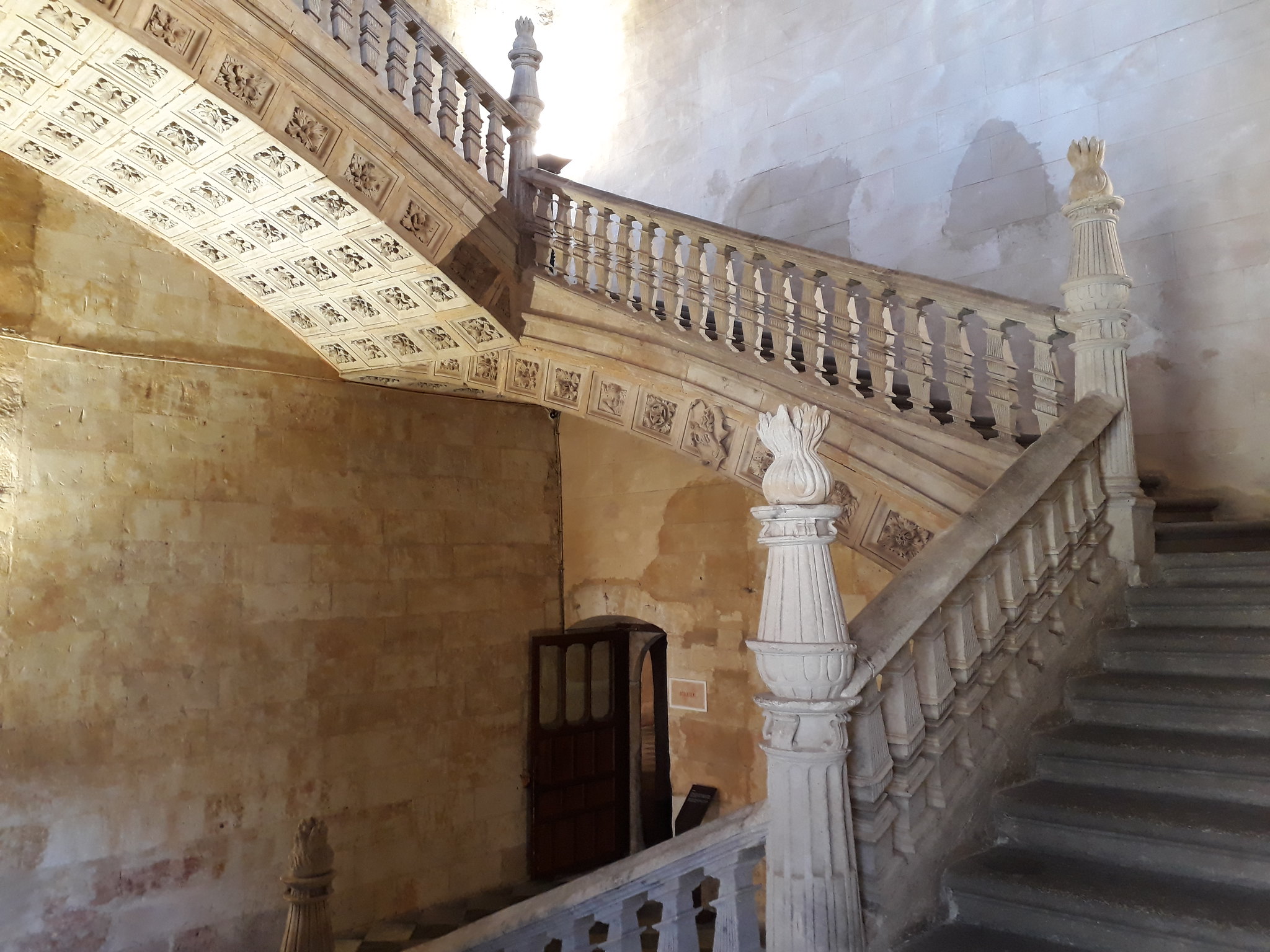
After passing by the Casa de las Conchas, I made my way to the Convento de San Esteban, a Dominican monastery built as early as the 13th century. Likewise with other architectural quirks in the rest of the city, this convent also had some wonders to marvel at. It was 3,50€ to get in, and it was a 3,50€ well-spent. Its two-story cloister was beautiful, both on the ground and top floors, along with the Soto Staircase with its winding steps and extravagant carvings underneath– definitely look up and admire them before heading up!

My lunch was a light one, as I opted for a hornazo— it’s essentially a local meat pastry filled with ham and other cured meats. Very salty, but also very bready; it was filling enough to keep me going for the rest of the day.

I headed back into the city center, where I made a stop at the escuelas Menores, one of the “minor” buildings that comprises of the University of Salamanca’s school network. It has a small courtyard, but what particularly drew me to this place was its El Cielo fresco, a brilliant 15th-century masterpiece that combined science, art, and religion into a single painting. The room in which it’s contained is extremely dim, as a way to naturally illuminate this stunning sky-blue artwork. It’s no surprise that one could sit and marvel at its beauty for a solid 15 minutes, as means of uncovering each scene and character in the painting.

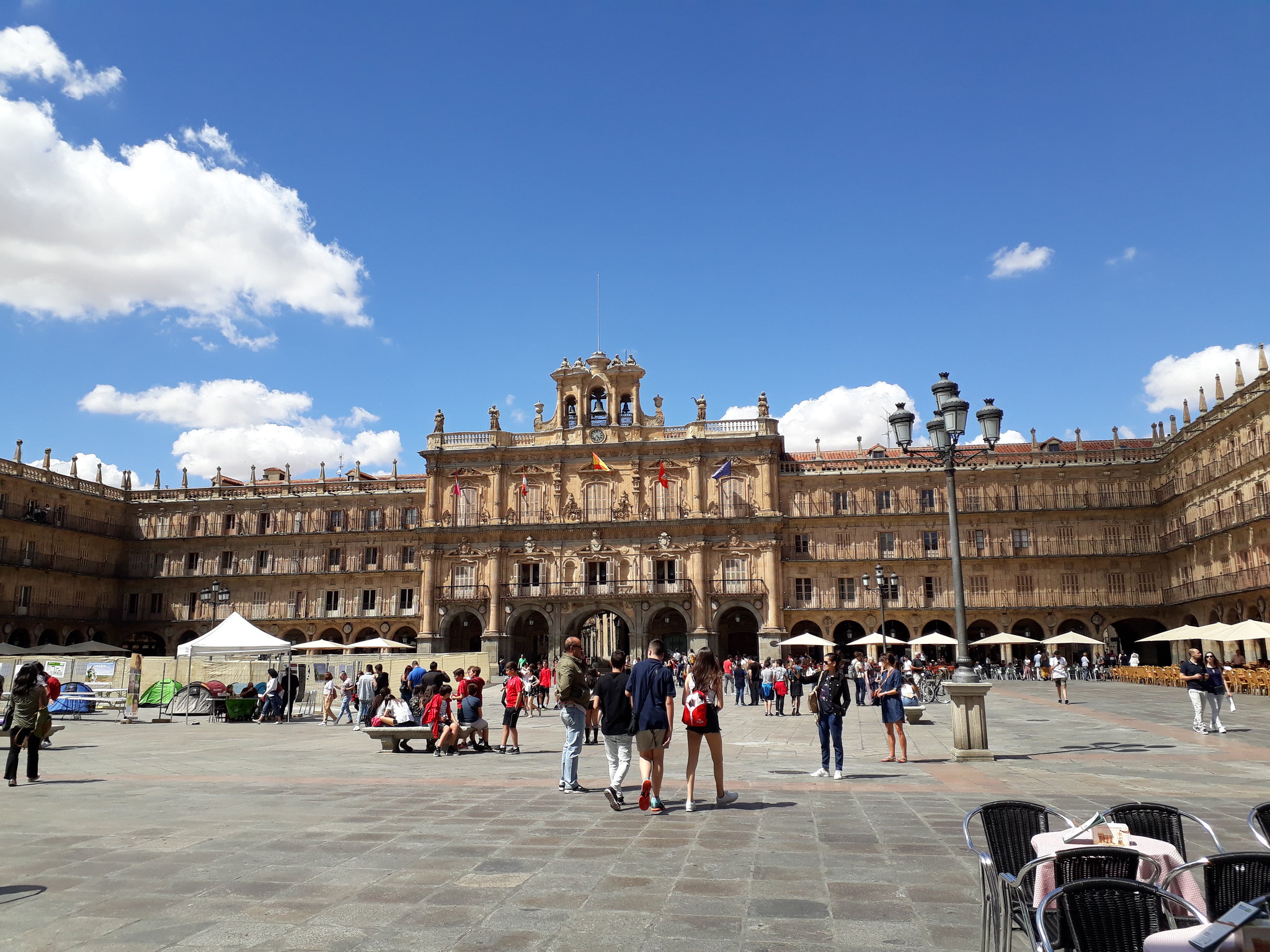
There was still a couple of hours left in my day’s visit to Salamanca. I went back-and-forth between Plaza Mayor and the Cathedral part of town as a result. The former is iconic in itself, with its golden buildings containing the massive courtyard, and its arches offering that beautiful photo opportunity. It’s considered one of the most-stunning plazas in Spain, and especially on a sunny, blue-sky day, it’s no surprise!
The last sight I saw for the day was the Ieronimus, the bell tower of the Salamanca Cathedral. It was 3,75€ admission to climb up to the top. The views weren’t very high up, but they were still really good. It was a bright and blue afternoon, which made the sights of the golden Old Town a pleasure to admire.

I slowly made my way back to the train station around 17:00, and I caught the train back to Madrid shortly thereafter. Overall, it was a solid six hours spent in Salamanca, and I greatly enjoyed it. What really stood out to me were the architectural quirks and sightings, from the frog statue to El Cielo. If I hadn’t done my research, I would’ve never known about them, let alone visit them. There’s so many hidden treasures to the city that I highly-encourage anyone to pay a visit– it really is that worth it!
Thanks for reading, and more of my time in Spain to come soon!
— Rebecca

 Rebecca Goes Rendezvous
I studied there, its so beautiful!
LikeLiked by 1 person
Salamanca really is lovely. Lucky you got to study there!
LikeLike
I love those quirky sculptural details – as you say, you wouldn’t necessarily spot them if you didn’t know where to look! I’ve not been to Salamanca (or Northern Spain at all, in fact!), but it looks well worth a visit 🙂
LikeLiked by 1 person
Doing research prior to visiting made all the difference! It was truly a pleasure spotting the quirky details in Salamanca, and I’d go back just to see more! It’s a lovely city with so much history and architectural sights to discover, and I do encourage you to visit some day!
LikeLiked by 1 person
Would you have liked to spend a longer amount of time there or was the 1 day enough?
LikeLiked by 1 person
I was able to see pretty much everything in one day, but I do encourage people to add an extra day if they want to take it slower!
LikeLiked by 1 person
Reblogged this on 100 Country Trek and commented:
This is a destination to add to your travel list.
LikeLike
Love this post…added it to my blog.
LikeLiked by 1 person
Thanks for the reblog!
LikeLike
Love your Blog..which is why I am following you as a fellow traveller.
LikeLiked by 1 person