Following my half-day trip to Carcassonne, I headed out again the next morning for another day trip to a nearby town in Toulouse. I chose to visit Albi, a small town about an hour’s drive from Toulouse. Although quite small and relatively off-the-touristy radar (at least, for international visitors), Albi nevertheless boasts a considerable amount of rich architectural history, as most of the town was built in red bricks.
Admittedly, I’d only heard about Albi just a month prior to visiting, as Anne from Present Perfect had mentioned this small town to me, as she’d been keen on visiting it, too. I didn’t know what there was to do there, but nevertheless I went in sans expectations and saw what it had to offer (spoiler alert: I was impressed).
Once again, I caught a BlaBlaCar ride over. I spent the hour’s drive in a pleasant conversation with the driver, who regularly commuted between Toulouse and Albi for work; he was kind enough to drop me right in the historic center, where I would be exploring for the day.
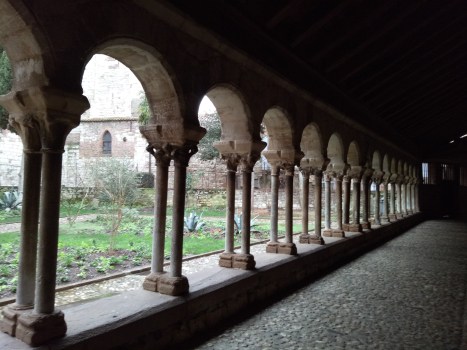
Unlike the previous day in Carcassonne, it was a bit drearier in Albi. Rain-slicked streets and grey skies greeted me in the morning, but fortunately it gave way to sunshine and blue skies by midday. All the same, the cobblestone streets were very charming, as I made my way to the cathedral. Along the way, I stopped by the collégiale Saint-Salvi, a Catholic church with a small, but nice cloister.
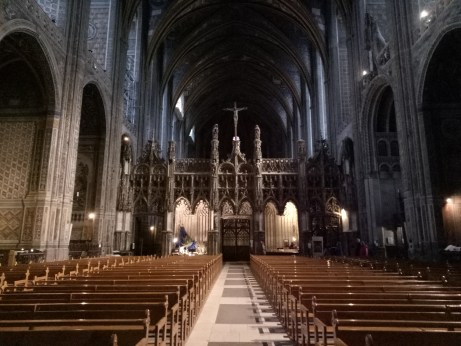
I eventually made my way to the cathedral, which absolutely towered in the middle of a spacious plaza filled with cafes, boulangeries, and other stores as the hub of the city. I entered the cathedral, whose nave still had Christmas trees on display– what especially caught my eye, though, was the choir room with an incredible rood screen. The cathedral itself is built in the Gothic style, but what makes it distinctive is that it was built almost entirely from red bricks, thereby giving it an earthy glow, as well as to the city.

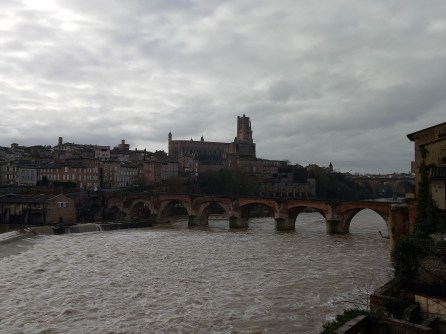
Following my visit, I made my way to the river, stopping by the Palais de la Berbie, a former Bishop’s Palace that today serves as an art museum on the works of Henri de Toulouse-Lautrec, who was born near Albi. The palace reminded me a lot of the Palais des Papes in Avignon, and I explored the gardens behind it, which had neatly-trimmed hedges and surprisingly-spectacular views of the Tarn River. I headed towards the river before strolling along the quay and crossing the Pont du 22 Août 1944 to the other side of town. From the musée Lapérouse (a museum dedicated to 18th-century local navigator, Lapérouse, who vanished in Oceania), I could get the iconic views of the cathedral with the Pont Vieux along the Tarn River– although it was sunny by then, the lighting was behind the cathedral, which unfortunately made my photos rather dark. All the same, it was a lovely sight to see.

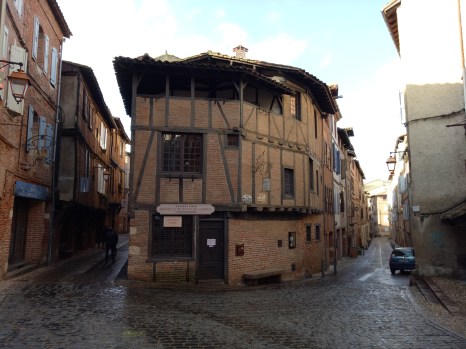
I returned to the other side of town, and wandered around the historic center some more. I visited the maison du Vieil Alby, a red-brick, half-timbered building that’d been built at an intersection of two streets, thereby giving its architecture a curved, pointed look– it’s one of the oldest-surviving buildings from its history, and it makes for a solid photo opportunity.
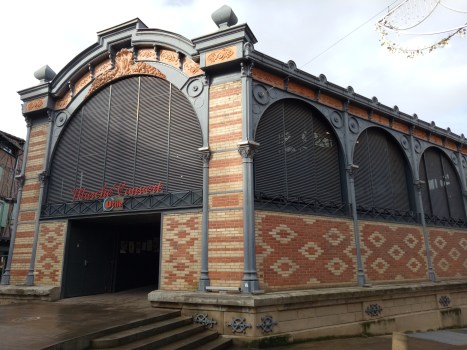
Nearing lunchtime, I headed to the marché Couvert, an indoor marketplace (“les Halles”) where I got a croque monsieur and a torsade au chocolat, the latter which is one of my favorite French pastries, even beating out the pain au chocolat (or should I say, “chocolatine?”). In general, it was a simple, but filling meal that kept me going for the rest of the afternoon.
After lunch, it was just a matter of wandering the historic streets, as I’d already seen the highlights of Albi. Eventually, I settled in a coffee shop where I got my *much-needed* chai latte and relaxed until it was time to catch my BlaBlaCar ride back to Toulouse. Close to 14:00, I headed to the meeting point in front of the train station, where my driver picked me and two other passengers up. My driver was a middle-aged woman who taught classes at the university, and we spoke about American and French cultures, which was stimulating. The ride passed quickly and soon enough, we made it back to Toulouse where she dropped us off near the Compans-Caffarelli metro station, and I made my way back to my friend’s house for the day.

Albi turned out to be a lovely visit, as I found the all-brick city charming and distinctive to the southwest region of France. It was quaint and gave a good representation of what French life is like in the area, and I’m glad to have stumbled upon this gem of a city.
That effectively ends my recap of my week-and-a-half-long visit to Paris and Toulouse right following New Year’s. Although I did and saw a lot, I also felt it slow-paced, as I had time to relax on some days and just take in the atmosphere of the cities and towns I visited. It was a good trip in between my busy, two-week affair with Italy and Spain, and my soon-to-be international trip to Budapest and Prague. Exploring the country in which I lived was a nice breather, all the while getting to see new places with the familiar.
I’ll be recapping my vacation to Budapest and Prague soon, so expect more posts to come. Thanks for reading, and until then!
— Rebecca

 Rebecca Goes Rendezvous
Nice pictures!
LikeLiked by 1 person
Thank you!
LikeLiked by 1 person
What’s the food scene in Albi? Do you like it?
LikeLiked by 1 person
I didn’t really try local dishes there, but I would assume that it follows the Occitaine/southwest France cuisine. Namely, a lot of slow-cooked dishes like cassoulet, lentils, even foie gras!
LikeLiked by 1 person
I went to Albi a couple of years ago and found it thoroughly charming. You have made me want to go again!
LikeLiked by 1 person
Albi wasn’t on my radar beforehand, but I’m so glad that I went! Charming is a good way to describe it. 🙂
LikeLike