While on the Danube river cruise last April with my parents, we hit up many spots along the way that were a bit off-the-beaten path of your usual “Vienna-Bratislava-Budapest” itinerary (although we did those, too. More on them later). Sailing away from Linz (where we’d actually opted for a day trip to Český Krumlov in the Czech Republic), we arrived in Melk the following morning.
Now, if Melk doesn’t ring a bell for you, then don’t worry: I admit, I hadn’t heard of it before, let alone knew what there was to do there. It’s a town with a population of perhaps five thousand people, which in my books classifies as a village. That said, I was unsure as to why it was part of the river cruise itinerary, except maybe as a way to see a bit of the lesser-known parts of the Danube, as a way of getting “cultured” perhaps.
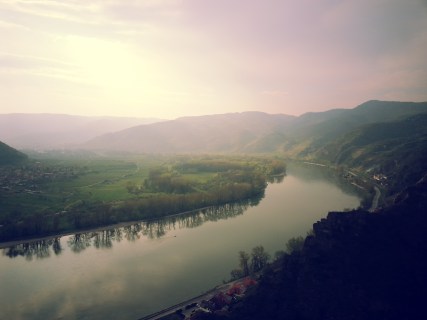
In fact, the reason why we were stopping in Melk and Dürnstein for the day was that both towns were situated in the Wachau, a famous and picturesque valley in Austria known for its lush, rolling hills and vineyards. It’s an UNESCO World Heritage Site and a huge tourist attraction for both the beautiful views and the excellent wine (of which I got to try some- not bad!). We were essentially sailing through the Wachau, and using Melk and Dürnstein as the two towns to straddle it.
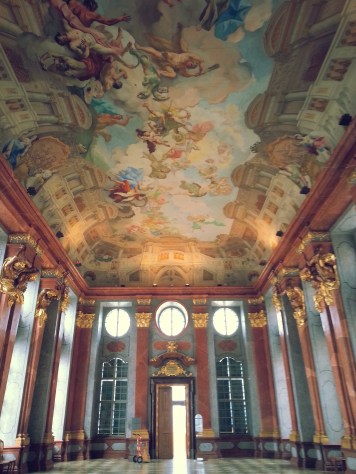
In any case, we spent half of the day in Melk, visiting its eponymous abbey, which is quite well-known. Spanning a period of one thousand years, it’s famous for its library, elegant and filled with books from floor to ceiling. Unfortunately, we weren’t allowed to take photos inside, but if you look up images online, then you’ll see what I mean by being absolutely breathtaking! Aside from that, the frescoes and lavish nave were not too shabby to look at, either.
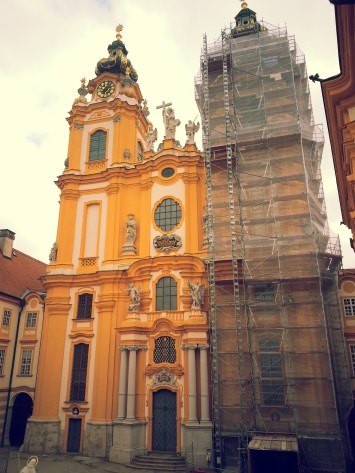
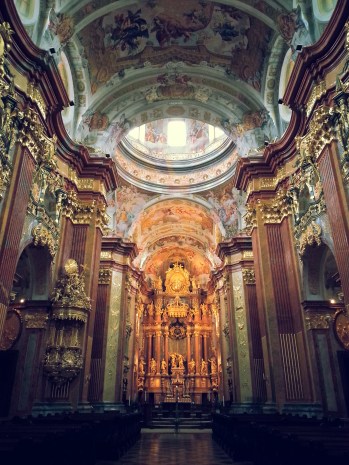
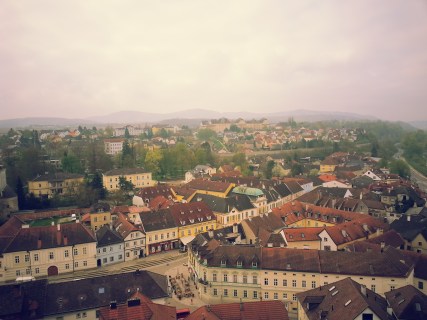

After no more than a three-hour visit of the abbey and the town center, we boarded our cruise ship around noon for lunch. At 14h00, the ship set sail along the Danube through the Wachau, as part of our “scenic tour” of the landscapes. We were invited up to the top deck for photos and commentary on the different landmarks we passed, before arriving in Dürnstein around 16h00. Although it’s classified as a “city,” Dürnstein is far from being one, at least population-wise with only 900 inhabitants (don’t know why the town insists it’s a “city,” though, so don’t ask me). It’s famous for having been the place where Richard the Lionheart had been held captive by the Duke of Austria back in the twelfth century, in a castle perched high on a hill that today remains only ruins. Aside from that, there wasn’t a whole lot to see in the town (sorry, “city”) center.
Interested in a bit of a hike, I decided to head up to the castle ruins with the time permitted in town. My parents chose to stay at the bottom to wait for me as I spent somewhere between 15 and 20 minutes scaling up the craggy steps to the top. I admit, it was quite steep, and although I was sweating quite a bit once I made it to the top, I was rewarded with some fantastic views of the Wachau! The castle ruins themselves were rich in history themselves, with much of it lost over the centuries; it was nice to weave through the small arches of the passageways for a little bit of exploration!
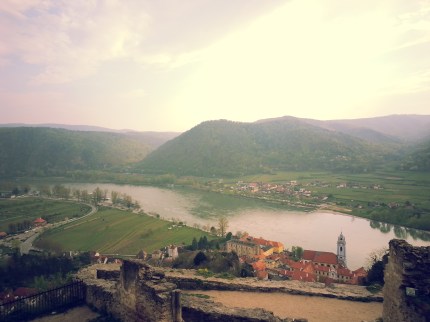
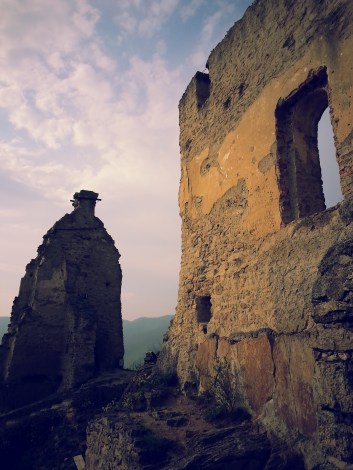
Around 17h00, I scaled down the hill to reconvene with my parents, and together we returned to the ship for the rest of the day. We set sail once more later that evening for our next destination along the Danube.
While our time in Melk and Dürnstein was very brief, and although there wasn’t a lot to see there, nevertheless it was a pleasant day. Considering that we’d just did more of a “strenuous” day trip in Český Krumlov the day before, and we would be doing the same the next day, it was a good way for us to relax and see a lovely gem in the Austrian countryside.
More to come soon! Next up: Vienna, Austria!
— Rebecca

 Rebecca Goes Rendezvous
I think Austria in general is underrated as far as non-skiing tourism is concerned. And no, being from Germany, I had never heard about Melk before either…
LikeLiked by 1 person
I agree! Austria is gorgeous and underrated. Melk is tiny, so one wouldn’t expect anyone to know about it, unless they’re from the region. 🙂
LikeLiked by 1 person
I would definitely say that it was worth the climb for that view. Absolutely gorgeous.
LikeLiked by 1 person
Very true! It wasn’t easy to scale up, but it was well-worth it in the end.
LikeLike
Melk Abbey looks stunning, definitely goes to show that when in Europe you have to remember to look up at the ceilings! I wonder how Dürnstein came to be listed as a city when it has so few inhabitants. Broadly speaking, if a settlement in the UK has a cathedral then it tends to acquire city status, so perhaps something similar happens in Austria. Nice to read about some hidden gems along the Danube!
LikeLiked by 2 people
Certainly helps to look up every once in a while for those gorgeous frescoes! No idea with Dürnstein, either, but all the same, it along with Melk are pretty to pass through- glad to have visited!
LikeLiked by 1 person
Marble hall & castle ruins is extraordinary looking. so many small details in at the marble hall. The ruins looks so serene and peaceful.
LikeLiked by 1 person
Melk Abbey and Dürnstein were certainly hidden gems along the Danube!
LikeLike
That had to have been an extraordinary experience!😄
LikeLiked by 1 person